Paul Graham, Silicon Valley investor and an essayist worth reading, notes that there are two senses in which writing can be good:
It can sound good, and the ideas can be right.
The first one might be something you can actually calculate, so I gave it a try and vibecoded a small tool: https://readability-analyzer.vercel.app/
You paste in English or German text and get back a set of readability scores. No AI, no backend, nothing leaves the browser.
Metrics that quantify readability
There are plenty of readability formulas, some of them decades old, that estimate how hard a text is to read. They look at sentence length, word length, syllable length and other things and combine them into a single score.
I picked several formulas, among them two of the best known: Flesch Reading Ease for English and the Wiener Sachtextformel for German.
Both languages need their own formulas: German words run long into monsters like Kraftfahrzeughaftpflichtversicherung, so an English formula reads perfectly normal German as far harder than it is.
How the tool is built
It’s a small Vite app, put together with Claude and Cursor. The analyzer runs entirely in the browser. No server, no API keys and no AI. Svelte is the UI framework and Vite bundles the code.
The actual work is done by three npm libraries that handle Flesch, Coleman Liau, Gunning Fog and the rest. The code lives on GitHub and every push triggers an automatic deployment on Vercel.
Turning scores into an LLM prompt
There is one more thing the tool spits out: an LLM prompt that combines all the scores with the original text. You paste that into an LLM like Claude or ChatGPT and it rewrites the input based on what the formulas flagged.
Eating my own dog food
I ran this post through it too, which is exactly where Paul Graham’s first sense comes back to bite.
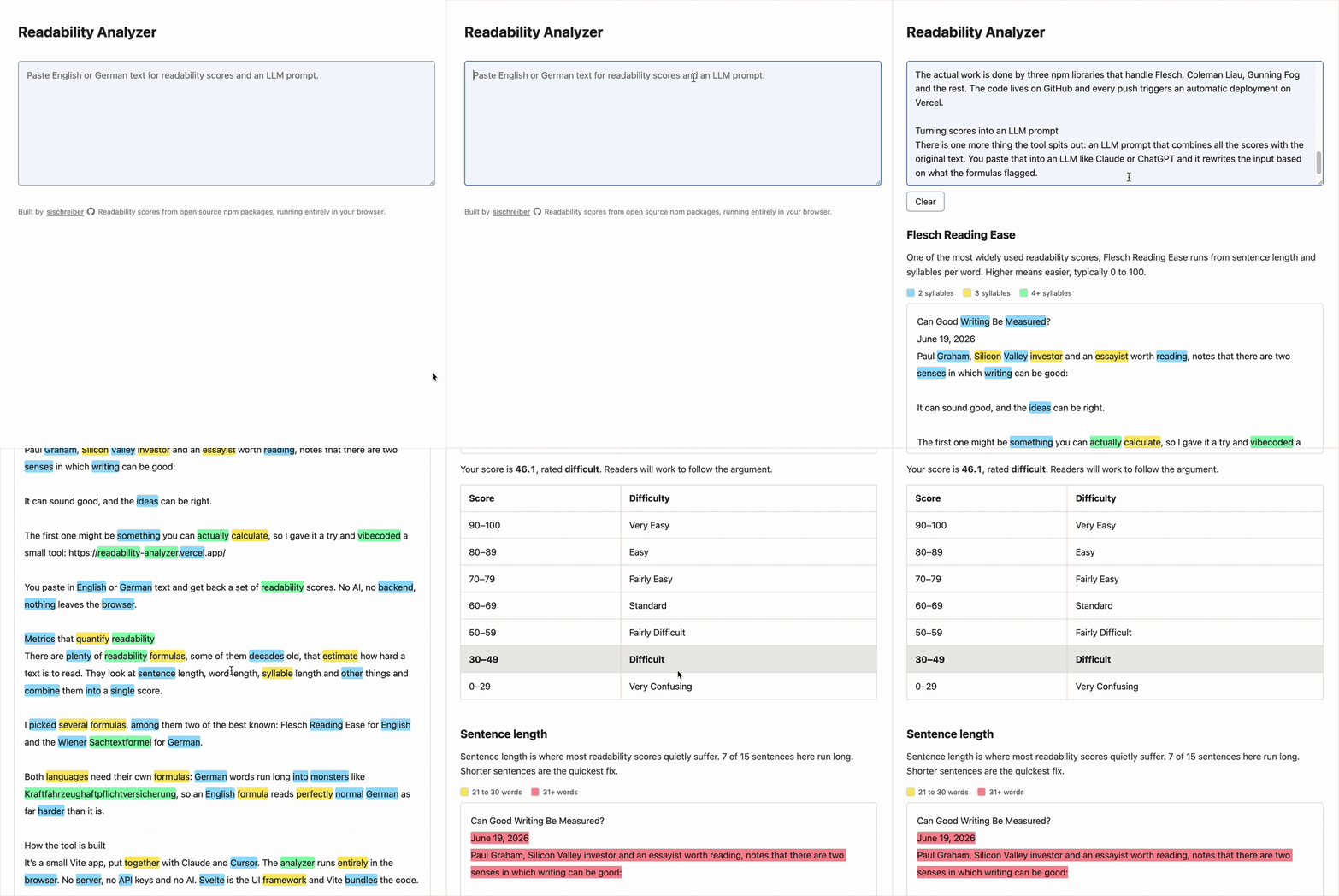
The tool flags a few long sentences, a bit of needless repetition and a reading level above where it probably should be.
All fair points. But long sentences are just how I write, something I already got called out for back in school and for now I am not going to change that to please a formula.
Inspiration
The tool is inspired by tiktokenizer.vercel.app which I like for its minimal UI built around a single use case.